

CRLT Occasional Papers
These short and informative Occasional Papers are written by CRLT staff and U-M faculty. They summarize the research on specific topics in teaching and learning and offer examples from courses at U-M and elsewhere. Recent issues include use of online collaboration tools such as Google Apps, use of laptops in the classroom, student teams in STEM courses, and best practices for designing and grading exams.
40. Motivating Students To Learn: Transforming Courses Using A Gameful Approach by Ronit Ajlen, Benjamin Plummer, Evan Straub, and Erping Zhu, 2020
39. The Michigan Sustainability Cases Initiative: Adapting Case-Based Teaching for Innovative Sustainability Science Education by Meghan Wagner, Stephanie Kusano, Rebecca Hardin, and Malinda Matney, 2019.
38. Supporting Students Facing Mental Health Challenges by Karishma Collette, Sara Armstrong, and Christine Simonian Bean, 2018.
37. Teaching in Teams: A Planning Guide for Successful Collaborations by Deborah Meizlish and Olivia Anderson, 2018.
36. Development and Assessment of Student Social/Civic Responsibility and Ethical Reasoning by Samantha K. Hallman, 2016.
35. Development and Assessment of Collaboration, Teamwork, and Communication by Stephanie M. Kusano, Amy J. Conger, and Mary C. Wright, 2016.
34. Development and Assessment of Self-Agency and the Ability to Innovate and Take Risks by Stephanie M. Kusano, Mary C. Wright, and Amy J. Conger, 2016.
33. Development and Assessment of Student Creativity by Samantha K. Hallman, Mary C. Wright, and Amy J. Conger, 2016.
32. Development and Assessment of Intercultural Engagement by Stephanie M. Kusano, Amy J. Conger, and Mary C. Wright, 2016.
31. Teaching in the Cloud: Leveraging Online Collaboration Tools to Enhance Student Engagement by Chad Hershock and Mika LaVaque-Manty, 2012.
29. Student Teams in the Engineering Classroom and Beyond: Setting up Students for Success by Cynthia J. Finelli, Inger Bergom, and Vilma Mesa, 2011.
28. The Importance of Teaching at the University of Michigan, 1996-2010 by Mary C. Wright, 2011.
25. Teaching for Retention In Science, Engineering, and Math Disciplines: A Guide for Faculty by Marie Kendall Brown, Chad Hershock, Cynthia J. Finelli, & Chris O'Neal, 2009.
24. Best Practices for Designing and Grading Exams by Mary Piontek, 2008.
23. Writing a Statement of Teaching Philosophy for the Academic Job Search by Chris O'Neal, Deborah Meizlish, and Matthew Kaplan, 2007. Revised 2019.
20. Promoting Academic Integrity in the Classroom by Deborah Meizlish, 2005.
19. Instructor Identity: The Impact of Gender and Race on Faculty Experiences with Teaching by Diana B. Kardia and Mary C. Wright, 2004.
18. Teaching Online by Erping Zhu, Patricia R. Payette, and Deborah DeZure, 2003.
- Explores some important considerations related to planning an online course and provides guidelines for instructional practices.
16. Research on Student Notetaking: Implications for Faculty and Graduate Student Instructors by Deborah DeZure, Matthew Kaplan, & Martha A. Deerman, 2001.
- Reviews what research tells us about the impact of notetaking and how the review of notes affects student learning. The paper also explores the role that instructors play, suggesting several specific strategies to support students.
13. Using Grants to Enhance Student Learning by Mary Wright, Constance E. Cook, & Elizabeth Brady, 2000.
- Presents the findings of interviews with nine UM faculty members who received instructional grants, exploring the effects of grants on the process of instructional reform and offering useful steps for furthering funded initiatives.
11. The Teaching Portfolio by Matthew Kaplan, 1998.
- Discusses the nature and purpose of the teaching portfolio (and its offshoot, the course portfolio), and provides suggestions for how individuals and units can use portfolios most effectively.
7. Perceptions of Faculty Behavior by Students of Color by Mark Chesler, 1997.
- Provides information from student focus groups and offers advice to faculty about ways to improve the classroom environment and help all students, including students of color, achieve their educational goals.
6. Learning with Lectures by Robert Kozma, 1994.
- Examines some important research findings about how students learn and then draws some implications for how lectures can be structured and delivered to help students understand.
Publications About CRLT
- CRLT's Annual Report describes the ways CRLT promoted excellence and innovation in teaching and learning at the University of Michigan in the past academic year.
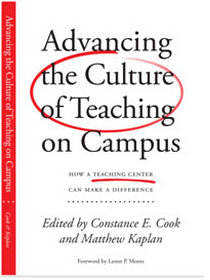 CRLT Book: As the oldest teaching center in the county and a recognized leader in the field of faculty development, CRLT has written a book that documents our approach, Advancing the Culture of Teaching on Campus: How a Teaching Center Can Make a Difference (Stylus Publishing, 2011). This volume contains chapters authored by CRLT professional staff describing CRLT's programs and strategies, such as leading a teaching center, measuring a center's effectiveness, and strengthening diversity through faculty development.
