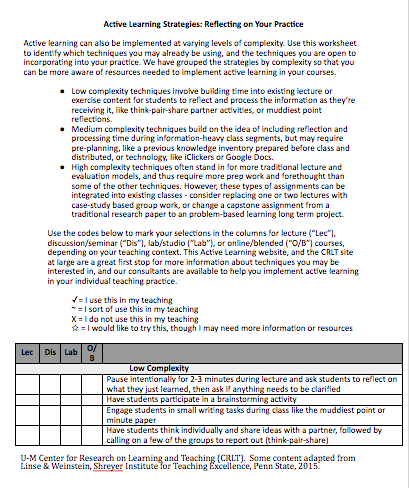
Active learning can also be implemented at varying levels of complexity. Use this worksheet to identify which techniques you may already be using, and the techniques you are open to incorporating into your practice. We have grouped the strategies by complexity so that you can be more aware of resources needed to implement active learning in your courses.
- Low complexity techniques involve building time into existing lecture or exercise content for students to reflect and process the information as they’re receiving it, like think-pair-share partner activities or "muddiest point" reflections.
- Medium complexity techniques build on the idea of including reflection and processing time during information-heavy class segments, but may require pre-planning. For example, a previous knowledge inventory prepared before class and distributed or the use of technology, like iClickers or Google Docs.
- High complexity techniques often stand in for more traditional lecture and evaluation models, and thus require more prep work and forethought than some of the other techniques. However, these types of assignments can be integrated into existing classes. For example, consider replacing one or two lectures with case study-based group work or change a capstone assignment from a traditional research paper to an problem-based learning, long-term project.
Use the codes below to mark your selections in the columns for lecture (“Lec”), discussion/seminar (“Dis”), lab/studio (“Lab”), or online/blended (“O/B”) courses, depending on your teaching context. You can enter them in the webform (your responses are not sent to CRLT) or download and print the PDF version. This active learning website, and the CRLT site at large, are a great first stop for more information about techniques you may be interested in. Our consultants are available to help you implement active learning in your individual teaching practice.
Y = I use this in my teaching
~ = I sort of use this in my teaching
N = I do not use this in my teaching
* = I would like to try this, though I may need more information or resources
| Lec | Dis | Lab | O/B | |||
Low Complexity | ||||||
| Lec | Dis | Lab | O/B | |||
Medium Complexity | ||||||
| Lec | Dis | Lab | O/B | |||
High Complexity | ||||||
| ||||||